
Total Recordable Incident Rate: How to Improve Your TRIR
Part of a successful safety strategy depends on capturing the right data, and then knowing how to use that information to improve your safety operations. One of the most essential metrics out there that a business should be tracking is their Total Recordable Incident Rate (TRIR). This metric is used to assess the safety performance of a company by comparing their total number of OSHA-recordable incidents relative to the total number of hours worked by their employees. In the eyes of OSHA, potential clients, or partners – the lower your TRIR, the safer your organization is to work with. In this article we’ll delve into what exactly a Total Recordable Incident Rate is, why it matters, how to calculate it, what factors impact your TRIR, and most importantly – how you can improve it.
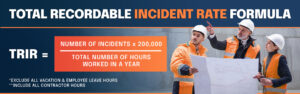
TRIR = Number of incidents x 200,000 / total number of employee hours worked in a year. The number “200,000” represents a base of 100 employees working 40 hours a week for 50 weeks per year.
What is TRIR and Why Is It Important?
Total Recordable Incident Rate (TRIR) is a key safety metric used across industries to measure how many recordable incidents occur for every 100 full-time employees over the course of one year. OSHA (Occupational Safety and Health Administration) defines recordable incidents as those that result in death, loss of consciousness, days away from work, restricted work, job transfer, or medical treatment beyond first aid.
TRIR matters because it offers insight into the overall safety performance of your organization. Companies with higher TRIR scores often face increased scrutiny from OSHA and higher insurance premiums. Moreover, high TRIR scores can impact your company’s reputation, making it harder to attract talent, customers, or secure business partnerships.
Factors That Can Impact Your TRIR
Several factors can negatively affect your organization’s TRIR. Here are some common contributors:
- Workplace Incidents: Unsafe working conditions or poor hazard identification can lead to more incidents that raise your TRIR.
- Lack of Employee Training: Inadequate or infrequent safety training can result in employees being unaware of best practices or hazards, leading to accidents.
- Ineffective Safety Procedures: If your safety procedures are outdated or poorly enforced, it can result in more recordable incidents.
- Underreporting: Some companies may attempt to lower their TRIR by underreporting incidents, but this can lead to long-term consequences, including serious regulatory penalties.
How to Improve Your TRIR
- Strengthen Safety Training Programs: A well-structured safety training program is essential to reducing incidents. Ensure that your employees understand the hazards they face and are trained on how to mitigate them. Regular training sessions can refresh their knowledge and introduce new safety protocols. Tailoring the training to the risks associated with each job role is also critical.
- Conduct Regular Safety Audits: Audits are an essential tool to identify potential hazards before they become serious problems. By regularly assessing your workplace, equipment, and processes, you can proactively address risks and keep your incident rate low. Safety audits should be an ongoing part of your safety program, not just a one-off activity.
Our safety program management solutions are customized to your business’s needs and fully managed by your team of dedicated safety professionals.
- Implement Hazard Reporting Systems: Encourage your employees to report unsafe conditions or near misses. When workers are engaged and take ownership of safety, your company will be more likely to catch hazards early and prevent future incidents. Moreover, creating a culture where employees feel comfortable reporting issues without fear of punishment can significantly lower incident rates.
- Modernize Your Safety Tech: Integrating technology, such as safety management software, can make tracking incidents and enforcing safety policies much easier. Software platforms can help identify patterns in incidents, track employee training, and automate the reporting process, allowing your safety program to run more efficiently and reducing the likelihood of recordable incidents.
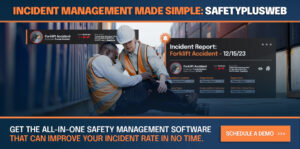
Simple incident management software for serious situations. Identify incident causes, record details, assign corrective actions, and auto-generate OSHA Logs.
- Set Clear Safety Goals: Establish measurable safety goals for your organization. Regularly track progress towards these goals using data-driven methods, and adjust your safety policies and practices as needed. Setting goals not only helps you manage TRIR, but it also fosters a culture of accountability and continuous improvement within the organization.
- Focus on Leading Indicators: While TRIR is a lagging indicator, meaning it shows what has already happened, focusing on leading indicators—such as near misses, hazard reporting, and safety training completion—can help you prevent future recordable incidents. Companies that invest in leading indicators often see their TRIR improve over time.
Take our free 5-minute quiz to see how effective your safety program is today and if there are any areas for improvement.
A Practical Path Forward to Lowering Your TRIR
Reducing your company’s Total Recordable Incident Rate (TRIR) can be a complex task, but it’s essential for improving safety outcomes and securing long-term growth. Many companies are finding that outsourcing safety management tasks to experts can significantly reduce their TRIR while also freeing up internal resources to focus on what they do best.
At Safety Plus, we’ve helped numerous companies, like SOLID Surface Care, successfully reduce their TRIR by helping them implement a comprehensive, data-driven outsourced safety program backed by our all-in-one safety management platform, SafetyPlus – Edge. Reflecting on his experience partnering with Safety Plus, SOLID’s Safety Director, Jim Crippen, shared, “With Safety Plus, we were able to take our safety program to the next level by implementing proactive training and behavior-based safety initiatives. This has helped us improve employee safety and reduce recordable incidents.”
If you’re looking to improve your safety outcomes, reduce incident rates, and build a more proactive safety culture, reach out to one of our safety experts today. Together, we can create a safer, more compliant, and more productive future for your organization.
Recommended Reading

Governance Is How Safety Earns Its Budget.
Every function in your business is expected to justify what it costs. Finance produces margin data. Operations produces throughput and efficiency numbers. Sales produces pipeline and close rates. When leadership asks whether the investment is worth it, every function has an answer built on performance data. Safety is the exception. Most safety programs justify their…

If You Can’t Answer “Is It Working?” You’re Managing Blind.
Here’s an uncomfortable truth about how safety performance gets measured in most industries: Why don’t zero incidents prove my safety program is working? Zero recorded incidents show what was reported during a period; they do not show whether hazards are being controlled or the program is improving. Review incident history alongside evidence of risk reduction,…

You’re Doing Safety. You’re Not Running It.
Most businesses doing safety look roughly the same from the outside. Training gets scheduled and completed. Inspections happen on a regular cycle. Incidents get documented. New hires go through orientation. The calendar stays busy. By any reasonable measure, the program looks active. But there’s a question that separates companies that are doing safety from companies…

Safety Consultant vs. Safety Management Company: What Is the Difference?
When operations leaders and business owners know they need outside safety help, the first question is usually which type. A safety consultant — or EHS consulting firm — delivers expertise for a defined engagement. A third party safety company or safety management company governs and administers an ongoing program. The difference matters because choosing the…
SAFETY MANAGEMENT SIMPLIFIED
Prevent Tragedy and Scale Effectively by Making Safe Work Efficient